Different systems. Not a trust problem, and not a preview of anything. Appearing in ChatGPT’s search answers depends on OpenAI’s own search crawler; appearing in Google’s AI answers depends on where you already sit in Google’s index.
The version of this I keep seeing reads the ChatGPT citation as an early sign that Google is about to catch up. The AI engines noticed you first and the rankings are on their way. The measured overlap between those two populations of pages argues against the whole sequence.
Three OpenAI bots, and only one decides search
OpenAI documents three bots and only one of them decides whether you show up in ChatGPT’s search answers. “OAI-SearchBot is for search. OAI-SearchBot is used to surface websites in search results in ChatGPT’s search features.” Sites that block it “will not be shown in ChatGPT search answers, though can still appear as navigational links.” GPTBot is training only, and ChatGPT-User “is not used to determine whether content may appear in Search.”
Google’s AI features are the opposite arrangement, and Google is direct about it in its generative AI optimization guide: “The best practices for SEO continue to be relevant because our generative AI features on Google Search are rooted in our core Search ranking and quality systems.” It describes retrieval as “relying on our core Search ranking systems to retrieve relevant, up-to-date web pages from our Search index.”
which means the two citations tell you completely different things. A page cited in AI Overviews or AI Mode got pulled out of Google’s own ranked index, so it tells you where you stand in Google. A page cited in ChatGPT tells you where you stand with OpenAI’s search crawler. People discuss both of those as one phenomenon called “AI search.”
How often does an AI citation also rank in Google?
Ahrefs ran 15,000 long-tail queries against Google and Bing and against ChatGPT, Gemini, Copilot and Perplexity, with data collected in early July 2025. Average overlap between AI-cited URLs and Google’s top 10 for the same prompt: 12%. Against Bing’s top 10: 10%. Perplexity ran highest at 28.6%; ChatGPT, Gemini and Copilot sat around 8% each.
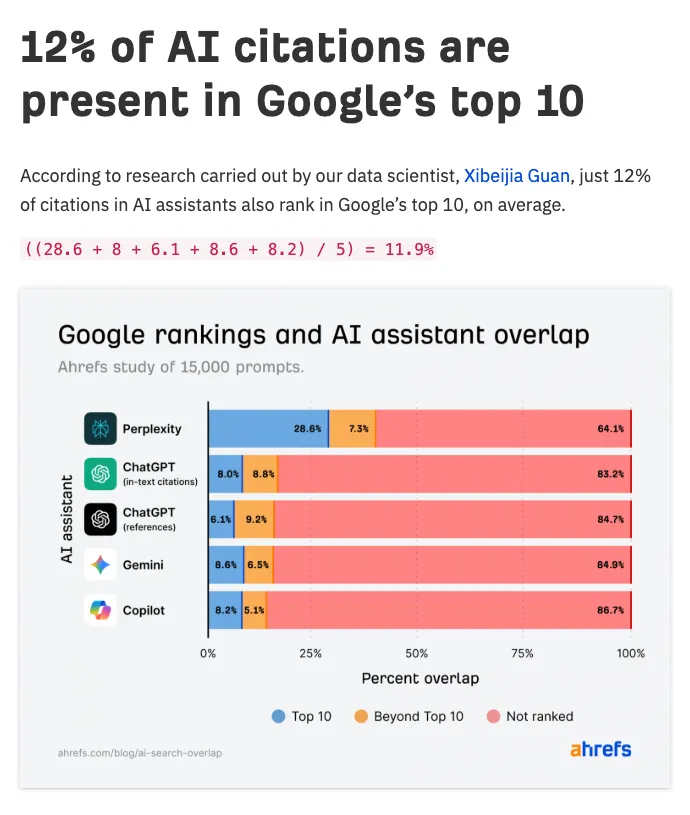
Ahrefs study of 15,000 prompts, captured 28 July 2026
The number underneath that is the one I would keep. Roughly 80% of AI citations do not rank anywhere in Google’s top 100 for the query that produced them.
So on these numbers, an AI engine citing you while Google shows you nothing is just the ordinary case.
The Seer study that looks like a contradiction
Somebody usually shows up with the other result, and it is a real study, not a blog post. Seer Interactive matched 500+ SearchGPT citations back to the queries that produced them in February 2025 and reported that “87%+ of SearchGPT’s citations matched Bing’s top organic results when the same exact question was used as a query, with most of those results appearing in the top 10 positions.” Google matched only 56%, at a median rank of 17 and an average of 28.
87% and 8% sound irreconcilable until you notice they are measured against different engines. Seer’s headline number is ChatGPT against Bing. Ahrefs’ is ChatGPT against Google. Seer’s own Google figure is the low one, and it lands in the same neighbourhood as the story Ahrefs tells. Both studies point the same direction: ChatGPT citations track Bing far more closely than they track Google.
The disagreement that survives is about magnitude, and about how much OpenAI now leans on its own index rather than Bing’s. The two studies are five months apart in a system that was moving during those five months.
That last question I could not resolve. OpenAI’s public documentation names OAI-SearchBot as its search crawler and says nothing about the retrieval stack behind it. Whether ChatGPT search today runs on Bing, on OpenAI’s own index or on some blend is not disclosed, and the secondary reporting on it contradicts itself. Any confident explanation of why ChatGPT cites you before Google ranks you is resting on that unknown.
The brand-mentions study measured AI Overviews
This is the one I would push hardest on.
Mueller was asked directly whether brand mentions without a link help SEO rankings and answered: “From my point of view, I don’t think we use those at all for things like PageRank or und[erstanding]…”
The study people cite against that is Ahrefs’ 75,000-brand correlation run from May 2025, where branded web mentions correlated 0.664 with brand presence, branded anchors 0.527, branded search volume 0.392, and backlinks trailed at 0.218. Those are strong-looking numbers and I understand why they get quoted. The problem is what sits on the other side of the correlation.
The outcome variable is brand presence in AI Overviews. The study measured how often a brand turns up in an AI-generated answer panel, which is a different question from whether the mentions moved anything in the ten blue links, and Ahrefs is not the one blurring it. Their write-up says “correlation does not equal causation. All the factors we studied revealed moderate to very weak correlations on the Spearman scale,” and notes that 26% of the brands studied had zero AI Overview mentions at all.
The finding is real. I just wish people would quote it for what it measured.
The new-domain question
Google’s position on the folklore is on the record and has been for years. Mueller in August 2019: “There is no sandbox.” And in 2017, asked directly whether domain age matters for ranking, he said no. He has also rejected the flattering version, the honeymoon period, in the same breath as the punitive one: “it’s again not the case that we’re explicitly trying to promote new content or demote new content. It’s just, we don’t know and we have to make assumptions.”
What Google publishes on timing is broad enough to fit almost any outcome. From the SEO starter guide: “Some changes might take effect in a few hours, others could take several months,” plus the reminder that not every change produces a noticeable effect at all. Google does put numbers on some of this, in the rollout durations it publishes for confirmed updates and in the several months it gives for recrawling and reprocessing a site. That is where I would start on a chart that looks stalled.
The base rates give you a floor to reason from. Of 1M random URLs first seen in September 2023, 1.74% reached Google’s top 10 inside a year. A second sample of 2M URLs created in October 2023, with blank pages and non-English content stripped out, came in at 6.11%. And 72.9% of the pages currently in the top 10 are more than three years old.
those are page-level base rates, though, and the argument is about domains. I could not find a study that isolates new-domain effects with a stated methodology. Google denies the mechanism on one side, practitioners report the pattern on the other, and there is no dataset in between. I hit the same standoff looking for a study on whether ranking curves step rather than climb, and it came back empty in the same way. “Sandbox” is a community coinage from around 2004, and as far as I can tell the question has sat exactly like that ever since. I am not going to close it with an inference.