
Batch re-evaluation is a real thing Google used to do, wrote a blog post about, and turned off ten years ago.
That is the part that never makes it into the explanation. “Google batches re-evaluation, so you sit flat for weeks and then a crawl pass re-scores a chunk of your pages at once” gets repeated as plumbing, by people who sound like they have read something. The closest thing to a source for it is the September 2016 Penguin announcement, and it points the other way:
“Penguin is now real-time. Historically, the list of sites affected by Penguin was periodically refreshed at the same time. Once a webmaster considerably improved their site and its presence on the internet, many of Google’s algorithms would take that into consideration very fast, but others, like Penguin, needed to be refreshed. With this change, Penguin’s data is refreshed in real time, so changes will be visible much faster, typically taking effect shortly after we recrawl and reindex a page.”
Google is describing periodic refresh as the thing it was fixing. Then it turned it off.
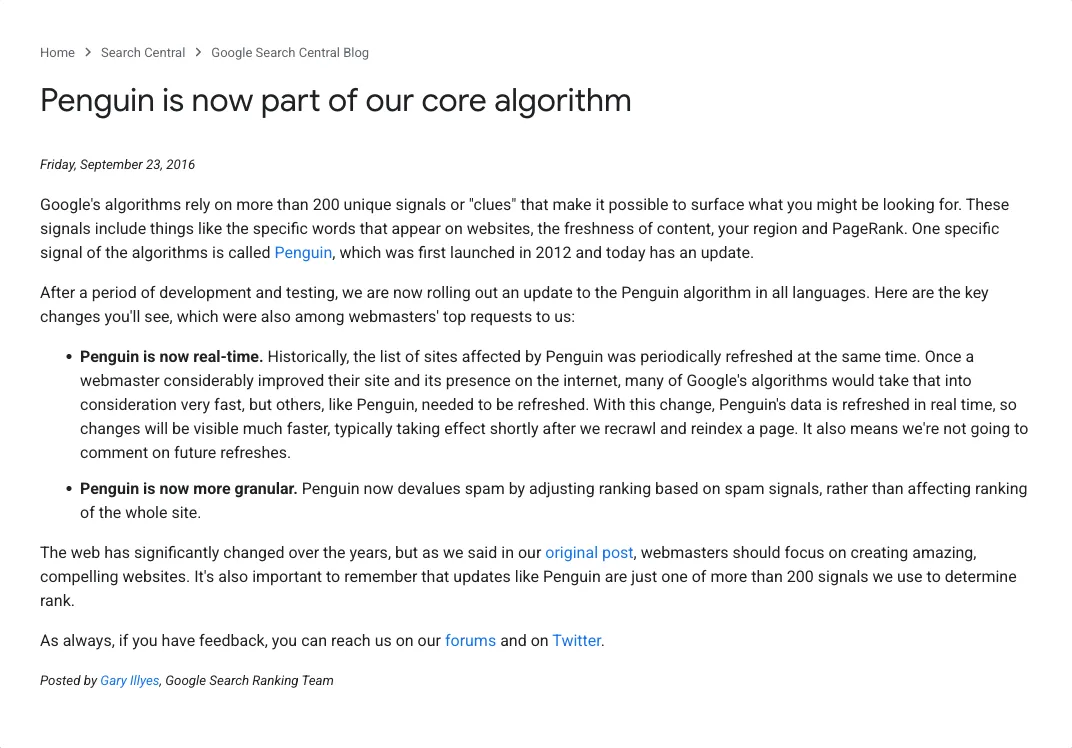
Google Search Central Blog, 23 September 2016, captured 28 July 2026
Everything else on the record says continuous
Google’s core updates documentation says you do not have to wait for one: “We’re continually making updates to our search algorithms, including smaller core updates.”
The August 2022 helpful content update post is more specific about the classifier itself: “Our classifier for this update runs continuously, allowing it to monitor newly-launched sites and existing ones.”
And the crawl-pass version of the story has a further problem, which is that indexing and ranking are not the same pipeline. Gary Illyes, replying to someone who claimed indexing and canonicalization slow down during core updates: “The posit is incorrect. Those systems are independent from the ‘core updates’.”
There is one staged behaviour Google does describe, and it is the thing the folklore is probably a garbled memory of. Mueller, on Bluesky in March 2026, explaining why core updates take weeks:
“We generally don’t announce ‘stages’ of core updates.. Since these are significant, broad changes to our search algorithms and systems, sometimes they have to work step-by-step, rather than all at one time. (It’s also why they can take a while to be fully live.)”
Read what that is a statement about. Google ships the update in stages. Your site is not sitting in a queue waiting to be scored.
What actually makes a chart look like a step?
Confirmed updates land on dates and take days or weeks to finish rolling out, and Google publishes the list with durations. The March 2024 core update ran 45 days. November 2024 took 23 days and 13 hours. March 2025 came in at 13 days and 21 hours, and May 2026 at 11 days and 21 hours. If a chart steps, the cheapest first move is checking whether the step lines up with a published rollout window.
Recrawl and reprocess latency is real and Google puts it in months. Mueller, in 2021: “Making significant quality changes across a site takes time to be picked up & reflected in search. These things often take several months to be reprocessed & reevaluated.” The core updates doc says the same in its own words, that some changes take effect in a few days “but it could take several months for our systems to learn and confirm that the site as a whole is now producing helpful, reliable, people-first content.”
Then there is ordinary noise, which Google names explicitly in the traffic-drop debugging guide: “positions aren’t static or fixed in place. Google’s search results are dynamic in nature because the open web itself is constantly changing.”
Resist the opposite assumption too, though. Slow is not the law either. In Ahrefs’ 2025 study of 1M and 2M URL samples, of the pages that did reach Google’s top 10, 40.82% got there inside their first month.
The shape of the curve
I went looking for a study on whether individual ranking trajectories are step shaped rather than gradual. Real numbers, and somebody willing to say how they measured it over time.
there isn’t one. What comes back is rank-tracker marketing pages and generic checklists that cite each other. The pattern gets described constantly and has never once been measured. The observation may well be real on any given site; the mechanism people attach to it is invented. I would separate those two before diagnosing anything.
Ranking works at the page level
The second one runs the other direction. Pages drop out of the index, and the reading is immediately site level: something tripped, the whole domain got marked down.
Google’s clearest statement on scope is in the March 2024 core update post, under the heading “What ranking signals does a site have?”:
“Our core ranking systems are primarily designed to work on the page level, using a variety of signals and systems to understand how to rank individual pages. We do have some site-wide signals that are also considered.”
The ranking systems guide repeats it and then adds the caution that kills the clean version of the story in both directions: “Having some good site-wide signals does not mean that all content from a site will always rank highly, just as having some poor site-wide signals does not mean all the content from a site will rank poorly.”
Site-wide signals do exist and Google has described one strongly. The August 2022 post again, which is the high-water mark for the site-wide reading:
“Any content, not just unhelpful content, on sites determined to have relatively high amounts of unhelpful content overall is less likely to perform well in Search, assuming there is other content elsewhere from the web that’s better to display.”
Two caveats travel with that quote and usually get dropped. It describes a ranking mechanism rather than an index-removal one, and those are different failure modes with different causes and different reports. And the standalone system it describes no longer exists. The ranking systems guide files the helpful content system under “Retired systems,” because Google folded it into core ranking in March 2024.
Same March 2024 post, one more line people should have taped to the monitor: “some third-party services provide ‘reputation’ or ‘authority’ scores for sites. These don’t correspond to any of Google’s own signals nor come from Google.”
That goes for AI visibility dashboards too. A ChatGPT citation is a reading off a different system, and the measured overlap between AI citations and Google’s top 10 averaged 12% across 15,000 queries.
The two statuses say much less than they get read as saying
The Page indexing report definition of the status that starts most of these threads, in full:
“Crawled - currently not indexed: The page was crawled by Google but not indexed. It may or may not be indexed in the future; no need to resubmit this URL for crawling.”
no quality language in it. Nothing about thin content, nothing about trust. It says the opposite of a verdict, actually, because the page may still be indexed later.
I looked specifically for a Google statement tying a spike in that status to a site-level trust or quality problem, because the whole community reading depends on one existing. I could not find it. Google links content quality to index selection in general terms in How Search Works, where low content quality appears in a list of common indexing issues. It never attaches that meaning to this label.
The neighbouring status is stranger, because the documentation reverses the folk explanation outright:
“Discovered - currently not indexed: The page was found by Google, but not crawled yet. Typically, Google wanted to crawl the URL but this was expected to overload the site; therefore Google rescheduled the crawl. This is why the last crawl date is empty on the report.”
The common read is that Google looked at the URL and decided it was not worth crawling. Google’s own wording is that it wanted to crawl and backed off to avoid hammering your host. That is a capacity story about your server, and it points at a completely different next move.
None of which means nothing is wrong. Google’s own list of what causes drops is algorithmic updates, technical issues, security issues, spam policy violations, seasonality and site moves, and it tells you to check the Manual Actions report, which is the one cause Google will actually tell you about. Its instruction for a large drop is to “self-assess your whole website overall (not just individual pages).”
If the pages are gone from the index, that is one report. If they still index and rank worse, that is a different one. Google’s debug page makes you pick before it will help you, and most of the threads I read never did.