
The clause is not in the Operating Agreement.
I went and looked, because every thread I have read on this says “it’s in the Amazon TOS” and then quotes a sentence with no citation attached. So I fetched the Associates Program Operating Agreement and searched it for shorteners, cloaking, masking and redirects. Nothing. What Section 1 says about links is that they “must properly use the special ‘tagged’ link formats we provide and comply with this Agreement,” and that is the whole of it.
The sentences people are arguing about are real. They are in a different document, they say something narrower than they get quoted as saying, and one of the two most-cited ones is pointed at a party nobody expects.
The document you want is the Program Policies
The Associates Program Policies page is not one document. It is a container holding several separately titled ones: the Commission Income Statement, the Participation Requirements, the Products Statement, the Mobile Application Policy, the Trademark Guidelines. Section numbers restart in each. So “Section 6” on its own does not identify anything, which is part of why these arguments never converge.
Both clauses are in the Participation Requirements, Section 6, the one headed “Content on your Site.” The UK version carries the same two clauses word for word, and I checked that rather than assuming it.
The Policies bind. The Commission Income Statement defines “Program Documents” to include them, and Amazon treats a breach of the Policies as a breach of the agreement. So the substance survives the bad citation. The rule people quote does not survive reading it.
The two documents get edited on different schedules and people quote stale copies, so check the date on whatever gets pasted at you. The Operating Agreement was updated October 15, 2025. The Program Policies were updated April 14, 2026.
And some rules that bite are in neither document. The ten qualifying sales Amazon wants before it grants API access show up only in API doc prose and an error-code table.
6(w) does not ban shorteners
The whole clause reads:
“You will not use a link shortening service, button, hyperlink or other ad placement in a manner that makes it unclear that you are linking to an Amazon Site.”
Read the middle. It does not say “you will not use a link shortening service.” It says you will not use one in a manner that produces a specific outcome, and it then names the outcome: a reader who cannot tell the link goes to Amazon. That is a clarity test, with a tool sitting in the example position.
The part that settles it is what Amazon actually does. Amazon ships a shortener and puts it in the affiliate toolbar. The SiteStripe help page, describing the “Get Link: Text” option, says it
“lets you build short and long links to the current Amazon page you are viewing. Your Associate ID and tracking ID are already included in the short link.”
A program that banned short links as a category would not generate them for you with the tracking ID pre-filled.
The one place Amazon addresses third-party shorteners is in the OneLink FAQ, question 6:
“Does OneLink work for all Amazon text links? Yes, as long as you have completed the one-time setup and use Amazon full links or Amazon short links on your site. Shortened links created by third-party link shorteners are currently not supported and will not be redirected.”
“Not supported and will not be redirected” is a compatibility statement about one feature. Amazon distinguishes its own short links, which work with OneLink, from third-party ones, which do not get rewritten. It did not write “are not permitted,” and I would not translate the one into the other on its behalf.
Two things I could not pin down. No Amazon-published page I found names the domain its short links use, so I am not going to name it either. And no Amazon source describes enforcement of 6(w) at all: what triggers a review, whether one ever happens, what the consequence is. Anyone who tells you a specific plugin or shortener is “compliant” is telling you something Amazon has never said about any named tool.
6(v) is a traceability rule
People quote this one as the anti-cloaking rule:
“You will not cloak, hide, spoof, or otherwise obscure the URL of your Site containing Special Links (including by use of Redirecting Links) or the user agent of the application in which Program Content is displayed or used such that we cannot reasonably determine the site or application from which a customer clicks through such Special Link to an Amazon Site.”
Look at the object of the verb. It is “the URL of your Site containing Special Links.” Not the URL of the Amazon page. And the test at the end is “such that we cannot reasonably determine the site or application from which a customer clicks through.”
The party being kept in the dark, in the conduct 6(v) prohibits, is Amazon. Amazon wants to know which site the click came from, and you are not allowed to break that.
That is a different thing from what most people mean when they say “cloaking an affiliate link,” which is usually about the reader not seeing an Amazon URL. Amazon does address the reader’s side, but it does it in the next clause along, with its own separate test. two clauses, two different parties, and everybody quotes one and means the other.
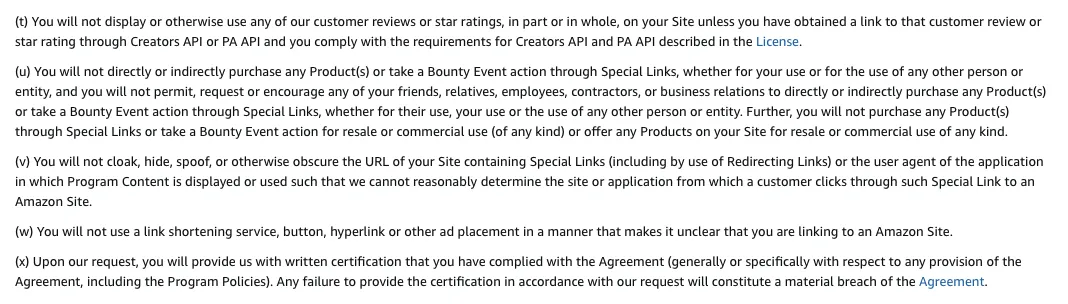
Amazon Associates Program Policies, Participation Requirements section 6, captured 28 July 2026
Where the Redirecting Link definition lives
“Redirecting Link” appears inside 6(v) as a parenthetical, which makes it look like a conduct term. It is defined somewhere else entirely, over in the Commission Income Statement, Section 2, under “Disqualified Purchases,” item (e).
“(e) any Product purchased by a customer who is referred to an Amazon Site by a link that sends users indirectly to an Amazon Site via an intermediate site, without requiring the customer to click on a link or take some other affirmative action on that intermediate site (a ‘Redirecting Link’),”
The consequence Amazon attaches is that the purchase “would otherwise be Qualified Purchases” but is “disqualified and excluded from the Associates Program.” Nobody bans you. The sale just does not pay.
And the definition has two elements that both have to be true. The link goes via an intermediate site, and the customer is not required to take an affirmative action on that intermediate site. A silent auto-forward through somebody else’s domain hits both. If the reader has to click something on the way, the second element fails.
The Participation Requirements say it again from another angle in 2(b):
“All Special Links must be accessed directly from your Site.”
and from the same paragraph:
“You must include your Associates ID or ‘tag’ (appearing as XXXXX-##, or such other format as we may designate) as a parameter in the URL of each link you place on your Site to an Amazon Site.”
If you are going to worry about one of these clauses, worry about this cluster rather than about 6(v).
The disclosure line is the only unconditional thing in here
Operating Agreement, Section 5:
“You must clearly and prominently state the following, or any substantially similar statement previously allowed under this Agreement, on your Site or any other location where Amazon may authorize your display or other use of Program Content: ‘As an Amazon Associate I earn from qualifying purchases.’”
Identical in the US agreement and the EU/UK one. I fetched both to check, because that is the kind of thing that quietly diverges. It has not. Separately, Participation Requirements 3(b) requires compliance with applicable disclosure law “including those related to disclosures (for example, if applicable, the U.S. FTC Guides Concerning the Use of Endorsement and Testimonials in Advertising).”
No manner test, no outcome test, no exceptions in the sentence. Everything else in here has a test attached. This one just tells you to do it, and it is the one people skip.
OneLink is Amazon’s answer to the cross-border question
The geo-redirect argument usually starts from the premise that one link cannot serve a US reader and a German one. The programs really are separate. Amazon’s setup page says so:
“Create an Amazon Associates account internationally - You will need an Amazon Associates account in each country for which you want to monetize the traffic.”
Schedule 1 of the US agreement covers exactly one site, amazon.com. Sign up in Europe and you are signing a different contract with a different Amazon company, Amazon Europe Core S.à r.l., and that one covers ten marketplaces at once. They do not even run under the same law: Washington State and AAA arbitration in King County on one side, the laws of Luxembourg on the other. Note the direction of the correction, though. Europe is one agreement across ten marketplaces, so “split per country” overstates the fragmentation there.
What does not follow is that you need a third-party redirect. Amazon built the tool. From the OneLink FAQ, question 1:
“OneLink is currently available for US Associates and can redirect international shoppers to the Amazon websites.”
The integration guide splits coverage into two groups: Canada plus the EU5 (UK, Spain, Germany, France, Italy), and then Japan, Singapore, Netherlands, Saudi Arabia, Poland, Sweden and Australia. Thirteen destination marketplaces. For the first group it is a checkbox in Associates Central and Amazon says you earn from those countries “using your single store ID.” For the second group you need an account per country, per the quote above.
The tag does not travel between marketplaces. Amazon’s description of the mechanism establishes that, in question 4:
“Mapping the store ID allows us to replace your US tracking ID(s) with your mapped tracking ID for the applicable Amazon Associates program when we redirect your international traffic internationally, thereby attributing conversions from global traffic to the respective Amazon Associates Account.”
If a US tag earned on amazon.de there would be nothing to map and nothing to replace. Earnings follow the destination program’s own commission table, accrue in that program’s account, and have to clear that program’s own minimum payout threshold before anything reaches you. That last part catches people: thirteen marketplaces means thirteen small balances, each with its own floor.
Default matching is “close match,” which sends a shopper to the local ASIN when Amazon finds the same or a similar product and falls back to a local search on the product title when it does not. You can switch to “exact match,” and the preference is set per tracking ID rather than per account.
Where the sources stop
I am leaving the gaps below open rather than filling them.
Start with the client-side geo-redirect. Say you rewrite the destination on your own page before the click, so the reader goes straight from your site to Amazon with no hop in between. Does that count as a “Redirecting Link”? The definition turns on whether an “intermediate site” is involved, and no Amazon guidance I could find applies that definition to that build. This is the actual crux of the geo-redirect question and it sits unresolved in the primary sources.
Third-party geo-redirection services are a separate gap. Both agreements are silent on geo-targeting entirely, and the only country and jurisdiction language in them is about sanctions, export controls and governing law. Silence is not permission and it is not prohibition, and I am not going to infer either.
Enforcement of 6(v) and 6(w). No Amazon source describes it. Every confident claim about accounts getting banned over link tools that I have seen traces back to another blog post.
Then there is OneLink outside the US. The help page says “currently available for US Associates.” Whether a UK-origin or EU-origin associate has an outbound tool, I do not know.
Marketplaces beyond the US and EU/UK. I compared those two and found 6(v), 6(w), the Redirecting Link definition and the Section 5 disclosure sentence identical between them. Canada, Japan, Australia and India I did not check, and consistency across two contracts is not consistency across all of them.
If someone tells you a specific plugin or shortener is compliant, ask which sentence they are reading.